Guide to Using the Past Networks Repository
The Past Networks Repository is a portal for discovering open-access datasets related to the human past. The repository contains metadata and links to external storage locations, where the datasets are stored, serving as a point of findability and discovery for practitioners and students interested in network research of the past. Access to the data is crucial to enable comparative studies to understand long-term change in the social networks of our species.
The core focus of the repository is on networks about the human past, setting it apart from other network repositories and collections. Time, historical context, and data uncertainties are not just metadata: they are central to how data is structured, searched, and interpreted. The flexible, yet structured design of the repository supports a wide range of time scales, accommodating projects that span from the distant past to more recent history, making the repository broadly applicable while maintaining a clear temporal structure and ease of data entry and search.
The repository is designed to be self-explanatory and prioritises usability, standards compliance, and flexibility for non-standard data, including datasets with uncertain parameters. Users can browse datasets through various visualisations, such as lists, maps, timelines, topic clusters, and co-authorship networks, and filter results interactively.
The repository's design is grounded in community-defined minimal documentation requirements, complemented by optional fields that reflect best practices and aspirational standards. In cases where community recommendations were not followed, this was a deliberate choice to preserve simplicity and avoid unnecessary complexity, for example, refraining from integrating third-party tools such as Zotero in order to maintain a simpler system architecture. Users retain flexibility nonetheless: DOIs, URLs, or formatted references can be included via a free-form text field to preserve informational richness.
1. Browsing and searching entries
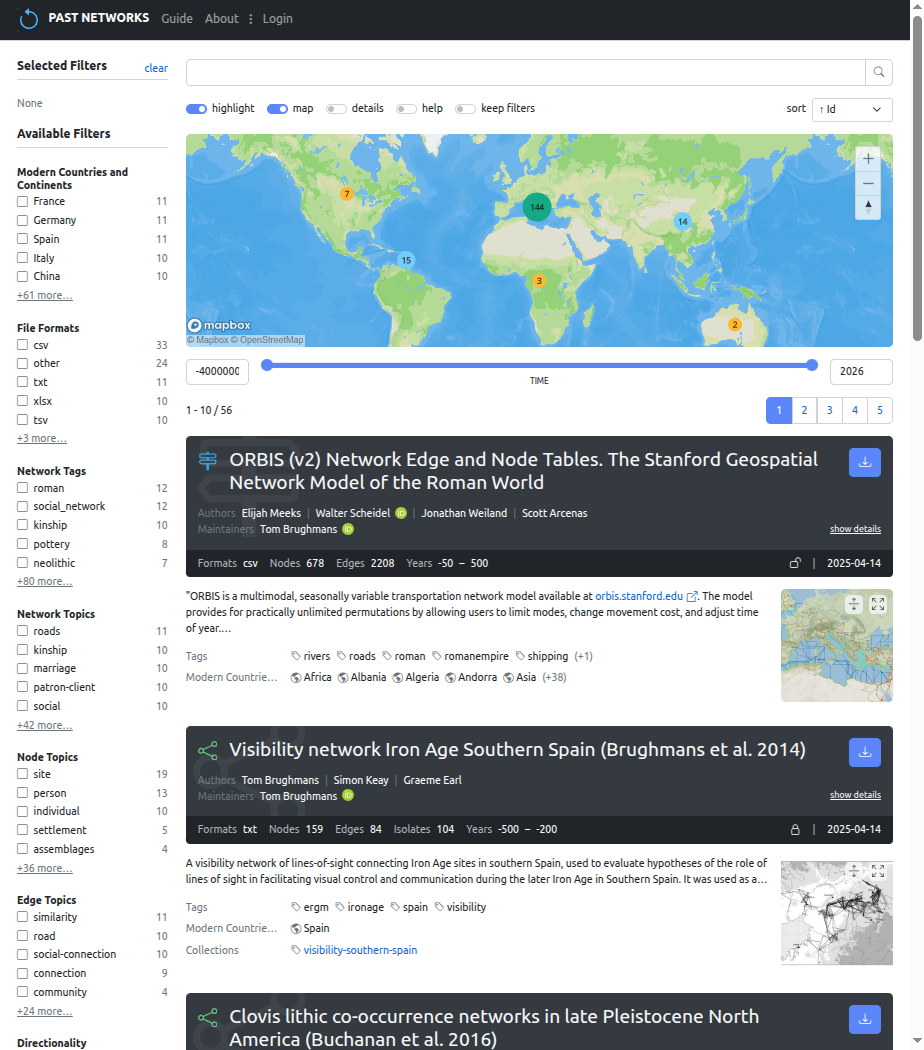
You do not need an account to browse or search the Past Networks Repository. The main page page shows all deposited network entries, 10 per page. For each entry, you can see the title, authors, maintainers, the number of nodes and edges, the chronological range, the data access status, the file formats, and a brief description. To see all available information for a single entry, click show details on that record; to expand all records at once, toggle details at the top of the page.
Filters
Users can filter networks easily based on their properties, such as topics, types of networks, and keywords, using prepopulated filters and tag-based suggester fields. A time slider allows for temporal exploration of datasets, while a spatial map provides a visual overview of dataset locations. Additionally, results can be sorted by criteria such as ID, name, or creation date, enabling users to quickly locate relevant records. This multi-layered approach to data access ensures that both casual browsers and expert researchers can navigate the repository efficiently and uncover meaningful connections across historical networks.
Use the filter panel on the left to narrow results by:
- Modern Countries and Continents : where the network is geographically situated
- File Formats: the format of the associated dataset (e.g. CSV, XLSX, TXT)
- Network Tags: community-assigned keywords
- Network Topics: the thematic focus of the network (e.g. roads, kinship, trade)
- Node Topics: what the nodes represent (e.g. person, settlement, site)
- Edge Topics: what the edges represent (e.g. road, kinship, similarity)
- Directionality: directed, undirected, or both
- Weighted: whether edges carry a weight value
- Open access only: show only entries whose data are freely accessible
You can apply multiple filters at once. Click clear to reset them.
Full-text search
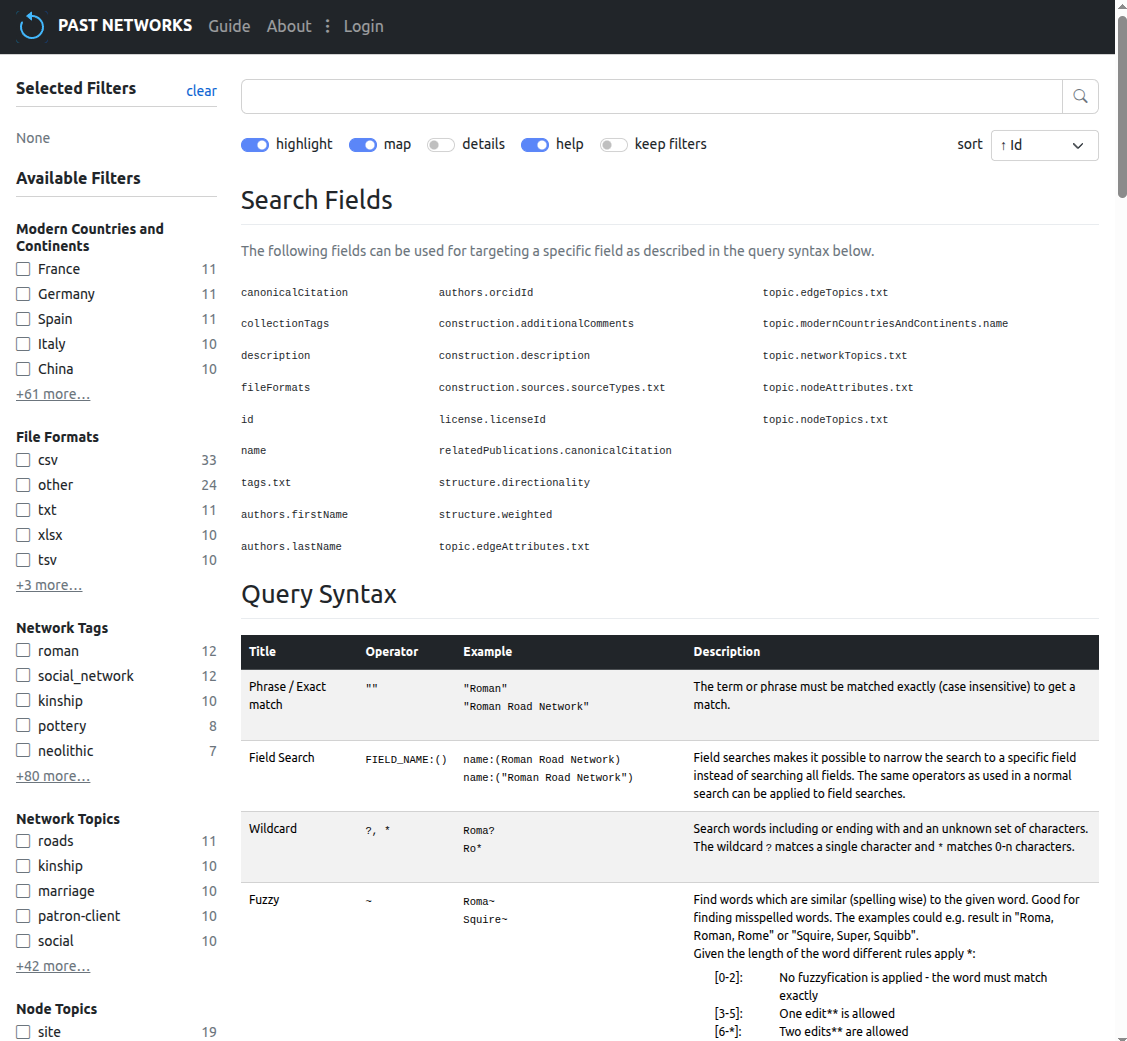
For more advanced users, the repository supports full-text search and Query Syntax, complete with eloquent examples to guide precise queries, available under the ‘help’ toggle option below the search box at the repository’s landing page. You can use the following operators to refine your search:
| Operator | Syntax | Example |
|---|---|---|
| Exact phrase | " " |
"Roman road" |
| Search a specific field | FIELD:(term) |
name:(Roman Road Network) |
| Single-character wildcard | ? |
Roma? |
| Multi-character wildcard | * |
Ro* |
| Fuzzy match | ~ |
Roma~ |
| Must include | + |
+Roman +Network |
| Must exclude | - |
-Roman |
| Grouping | ( ) |
(+Roman +Road) (+Ancient +Network) |
Sorting and display options
You can sort the results by ID or name, in ascending or descending order, using the controls above the list. You can also switch to a map view or expand entries to show more detail directly in the list.
Viewing an Entry
Click on any entry title to open its complete documentation record, where all 55 attributes (when available) are displayed across four sections (see Section 4 for a full explanation of the schema).
2. What qualifies as a past network?
The repository accepts descriptions of datasets relating to past human phenomena. A qualifying entry is a dataset that includes relationships (edges) between entities (nodes) derived from historical or archaeological sources, or historical and archaeological datasets that have been used to make network representations (i.e. the dataset does not have to be in a network data format, but needs to be transformable into network data). Both empirical networks ( reconstructed directly from sources) and modelled networks (constructed through inference or simulation) are accepted, provided the construction process is documented.
The datasets must be published, either as a standard academic publication, preprint, supplementary material, or deposited in an online repository, such as Zenodo or similar, or institutional or publisher repositories.
If you are uncertain whether your dataset qualifies, consult the Code of Conduct or contact the maintainers ( see Sections 8 and 9).
Licensing
We strongly encourage practitioners to publish their datasets and findings under open licenses, such as the Creative Commons licenses, as a standard practice. Metadata for individual dataset records contain their own licensing information. The responsibility for data quality, accuracy, and updates lies with the original record maintainers, not with the Past Networks Repository. The repository serves as a discovery platform and does not assume liability for errors or outdated information.
3. Creating an account
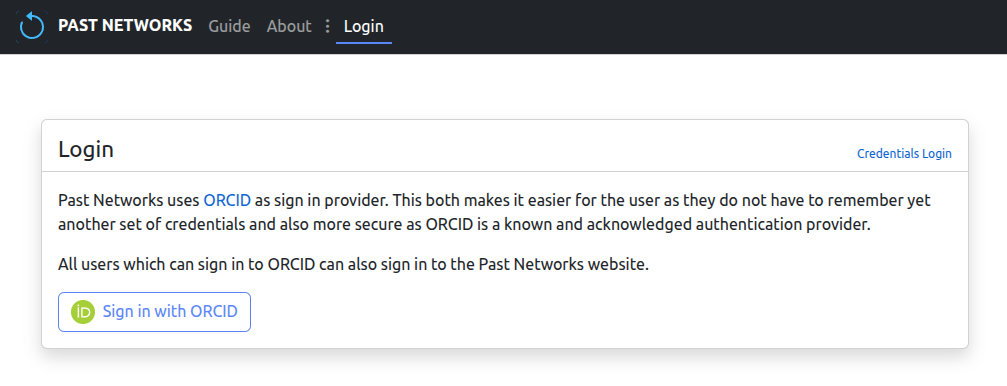
To deposit or edit entries, you need to log in using your ORCID account - the persistent identifier system for researchers.
- If you do not already have an ORCID ID, register for free at orcid.org.
- Click Login in the navigation bar and authenticate with your ORCID credentials.
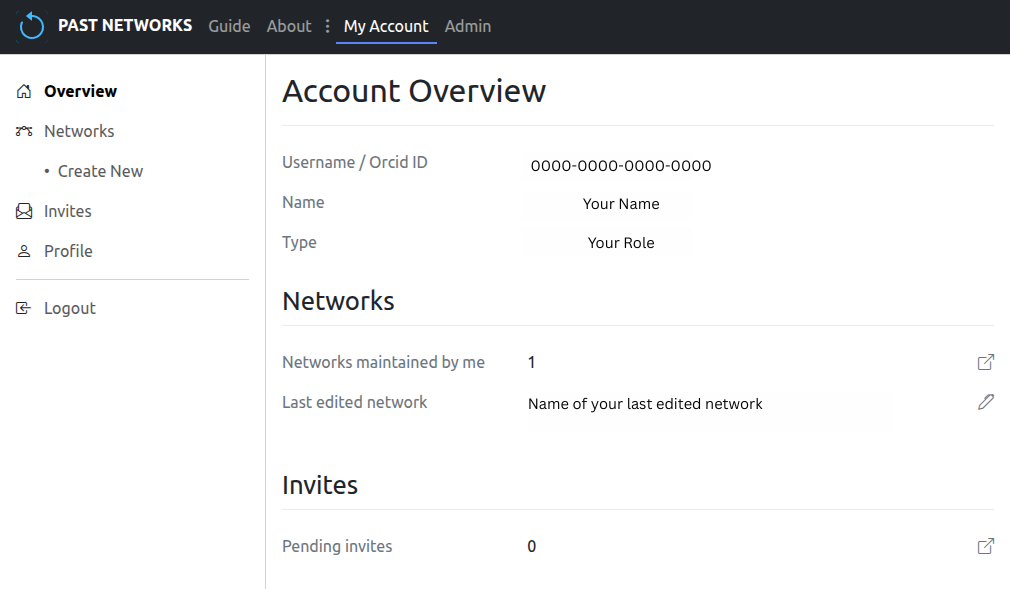
- Once logged in, your account dashboard with an overview is accessible via My Account.
Maintainer role
Once authenticated via ORCID, users can create and manage records (maintainer role), as well as invite other registered users to collaborate on their records. The maintainer of a record does not necessarily have to be one of the authors who created the original dataset or the publication. However, the maintainer will be responsible for the quality of the record entered into the repository. The maintainer can draft, publish, edit and download the data they created as an ndJSON file. They can invite other users to collaborate on a record and become a co-maintainer. Maintainers can be informed of incorrect information on the records they maintain via their ORCID profile. Importantly, only the original maintainer, who created the record or a repository administrator, has the authority to delete it.
Account overview
In the My Account Overview, you can see and manage the network records you maintain (i.e., edit one by one, delete, or download them individually or all as ndjson), access your invites to maintain someone else's records, edit your profile, or invite someone as a maintainer to your records. You can create new networks via the Networks panel on the left.
You can duplicate or delete the existing records.
Duplication: Duplication is intended for situations when multiple network datasets were published within one source/publication/project and should be used with caution. Not all fields are duplicated, i.e. the name of the record needs to be unique.
Deletion: Once a record is deleted, the action is irreversible. Only the original maintainer, who created the record or a repository administrator, has the authority to delete it. See Section 6 for details.
4. Creating a new entry
To deposit a network:
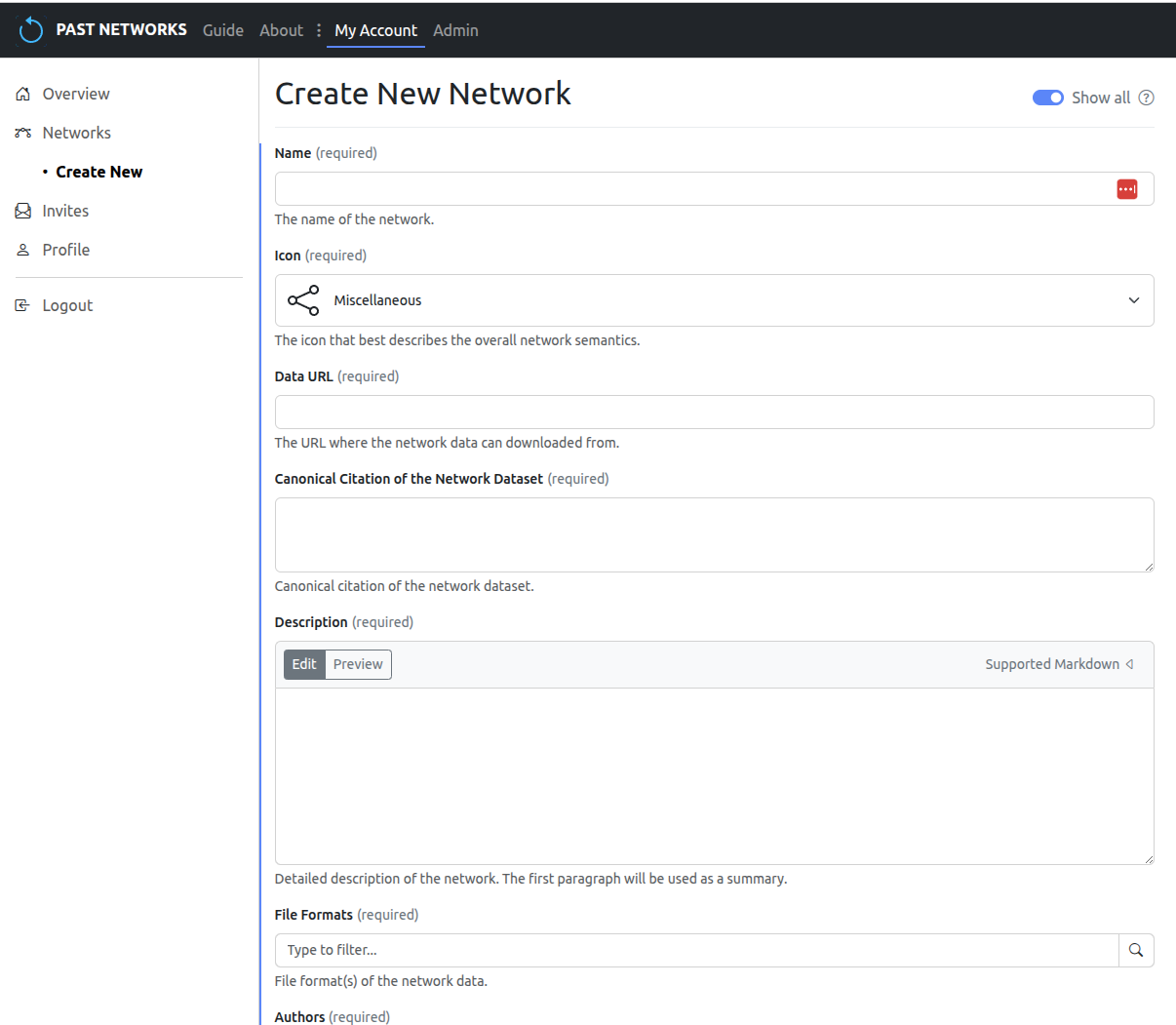
- Go to My Account → Networks → Create New.
- Complete the data entry form. All fields should be self-explanatory; however, if more explanation is needed, each field includes a ? tooltip with a brief explanation of the expected content.
- Save your entry as a draft at any point, or submit it for publication when complete. Once you publish the record, it will instantly become accessible via the main page search.
Each field indicates whether it is required or optional. You must provide all required fields before you can publish the record. Longer text fields support Markdown syntax, with a preview toggle option. You can also upload multiple images (<2MB) that best represent the network dataset, including a caption. Several fields have the option to add multiple records, such as Author, Related Publication, and Source.
Each record has a unique stable URI in the format https://pastnetworks.org/networks/[numeric ID], for
example, https://pastnetworks.org/networks/10. If a record is deleted, its URI will remain empty, and the ID will not be
reissued. See Section 7 for details.
Understanding the structure of the repository
The repository uses a structured schema of 55 attributes grouped into four thematic sections. Of these, 27 are mandatory and constitute the minimum best-practice documentation requirements; the remaining 28 are optional and reflect community recommendations for more complete records. All mandatory fields must be completed before an entry can be published.
| Section | Total attributes | Mandatory | Optional |
|---|---|---|---|
| Essential identification and authorship | 22 | 13 | 9 |
| Network topic | 13 | 6 | 7 |
| Technical parameters | 14 | 4 | 10 |
| Network construction | 6 | 4 | 2 |
| Total | 55 | 27 | 28 |
Mandatory fields are marked in the form. You cannot publish an entry until all mandatory fields are complete. We encourage you to complete as many optional fields as possible: richer documentation increases the discoverability and reusability of your dataset.
1. Essential identification and authorship
This section captures the core bibliographic and administrative metadata for the entry: where the network is deposited, where it has been published, who created it, and under what conditions it may be accessed and reused. It provides interested users with a basic overview of the network's provenance and access to the data, as well as published research.
2. Network topic
Network datasets contain rich semantic information that defines their topical scope, temporal boundaries, and structural characteristics. Understanding the meaning and context of network elements, i.e. what the nodes and edges represent, when and where the network existed, and what additional attributes are captured, is crucial for researchers to assess the dataset's relevance to their research questions and to interpret findings appropriately.
Chronological data: To ensure chronological consistency and support for meaningful comparisons across datasets, contributors are required to specify both from and to years for each record. The system excludes the year zero to maintain historical accuracy and clarity. This design supports a wide range of time scales, accommodating projects that span from the distant past to more recent history. This flexibility makes the repository broadly applicable while maintaining a clear temporal structure and ease of data entry and search.
3. Technical parameters
While these are not mandatory, since not all projects collect every technical detail, we strongly encourage contributors to publish quantitative descriptors whenever possible. Doing so enhances the analytical value of the dataset and supports more robust comparative and computational research. This section records the quantitative structural properties of the network, such as whether the network is directed, weighted, uni- or bipartite, multilayer, its size parameters and other standard network metrics. These attributes enable users to assess the scale and structure of a network before downloading or citing it.
4. Network construction
This section captures the details of how the network was constructed, providing essential context for understanding its provenance and reliability. Contributors are expected to include high-level descriptions of the data curation process, outlining the actions taken during network construction and their implications. Each dataset must also include a list of sources used to create the network, along with detailed descriptions and source types. These may include bibliographic references or links to primary data repositories or publications that detail the source material. Where applicable, contributors should provide a link to the code used for data curation or to a publication that explains the curation methodology. An optional field for additional comments allows contributors to note caveats, elaborate on relational models or processes underlying the network, and suggest how the data might be reused. Thorough completion of this section is essential for reproducibility and is strongly encouraged even for optional fields.
5. Editing an existing entry
You may edit any entry you have deposited at any time.
- Go to My Account → Networks.
- Locate the entry and select Edit.
- Amend the relevant fields and save. If you need to update an entry that was deposited by someone else, contact the maintainers (see Section 8).
6. Deleting an entry
To delete an entry you have deposited:
- Go to My Account → Networks.
- Locate the entry and select Delete.
- Confirm the deletion when prompted.
Note: deletion is permanent. If your dataset has been cited or linked elsewhere, consider updating the entry rather than deleting it, or contacting the administrators at pastnetworks@au.dk to discuss archiving options.
7. Exporting and citing data
For bulk export or programmatic access to repository metadata, refer to the About page with daily dumps of all records. Each night, a full export of all published network records is automatically generated in NDJSON format, with each line representing a single JSON network object, under the “No Rights Reserved” Public domain license (CC0 1.0 Universal).
To cite a repository entry, use the citation information provided on each entry's detail page.
Each record has a unique stable URI in the format https://pastnetworks.org/networks/[numeric ID], for
example, https://pastnetworks.org/networks/10. If a record is deleted, its URI will remain empty, and the ID will not be
reissued.
Where a dataset has a DOI (deposited in an external repository such as Zenodo), preference should be given to citing that DOI directly in accordance with your discipline's citation conventions.
Citing the repository
Brughmans, T., Hermankova, P., Mazzamurro, M., Bjerregaard Vahlstrup, P., and Møldrup-Dalum, P. 2025. Past Networks: the open online repository portal for network data about the human past. https://pastnetworks.org
8. Reporting issues and contacting maintainers
For questions about the repository, problems with the platform, or requests to update entries you did not deposit or do not maintain, contact the Past Networks team via pastnetworks@au.dk email.
To report a content issue with a specific entry (e.g., factual error, licensing concern), contact the maintainers directly. Each record has its maintainer along with their ORCID listed as part of available metadata.
9. Terms of Use and Code of Conduct
All use of the Past Networks Repository is governed by the Terms of Use and the Code of Conduct. Depositors are responsible for ensuring they hold the rights to any data they submit and that their chosen licence accurately reflects those rights.